Teaching real Vietnamese to foreigners with a 100-million-word corpus
Learners of Vietnamese as a foreign language need to see how words are really used, but the corpora used for teaching so far held only online news. This paper takes VnC 1.0, a balanced corpus of written and spoken Vietnamese the group built earlier, and turns it into teaching material: word lists ranked by use, the meaning of a word to teach first, graded readings, and real example sentences for any word.
A learner looks up “ăn kiêng”. What does the corpus give back?
Every line is a real sentence from VnC 1.0, lined up on the word. Tap a line for an English gloss.
ăn kiêngto diet (literally “eat” + “abstain”)
Source: Figure 4 of the paper, all 10 lines, transcribed (right contexts cut off at the paper’s page margin end in “…”). English glosses are ours, not the paper’s. Line 5, Tại sao bạn không bắt đầu ăn kiêng? (“Why don’t you start dieting?”), follows us through the page.
A is a large, organised collection of real texts that a computer can search and count. Looking a word up in it does not return a definition. It returns every place the word was actually used, lined up so you can see what comes before and after. This view is called a .
Think of it asInstead of asking a teacher to invent an example sentence, you stand in a library with a hundred million words and ask: “show me everyone who has said this”.
Look at the hero above. Six of the ten lines put chế_độ (“regime”) right before ăn kiêng. No dictionary entry would tell a learner that “diet regime” is how this word usually travels. The corpus does, in a second.
100,189,286words in VnC 1.0 (the paper’s N)
90% / 10%written / spoken texts
3regions sampled: North, Centre, South
334most common words cover more than 60% of the corpus
91.356%of the corpus covered by the top 3,334 words
1 · The gap
Corpora help language learners. Vietnamese didn’t have a balanced one.
Vietnamese is one of the 20 most widely spoken languages in the world, and more foreigners come to Vietnam to live and work every year. Teachers have tried many methods with them: the communicative method, teaching through idioms and proverbs, teaching speech acts with an eye on intercultural communication. One more route is to let real text do the teaching.
For English and other languages, that route is well travelled. Click through the studies the paper reviews.
From 1987 to today: teaching with corpora abroad, and in Vietnam
Tap a dot to read what that study found.
Studies abroad (English, German, Japanese, Indonesian)Studies on VietnameseThis paper
Source: Section 2 of the paper. Years come from the text; for studies the text gives no year (marked *), the year is taken from the paper’s reference list.
The blue lane shows a steady result: learners who search real text understand grammar faster, enjoy vocabulary work more, and want to keep using the tool. In one Japanese study, 80% of students said they wanted to use a concordance tool regularly for self-study.
The red lane shows the Vietnamese gap. The two monolingual corpora used for teaching Vietnamese so far, VCor and VTB, were built only from online newspapers. News is one kind of Vietnamese. It is not how people talk, write stories or draft reports.
2 · The corpus behind it
The tool already exists: VnC 1.0, a balanced corpus of written and spoken Vietnamese
This paper does not start from an empty folder. VnC 1.0 was built earlier by the same group (see VnC 1.0 Explained for how). Here the authors recap its design, because what a corpus contains decides what it can teach: if it held only newspapers, every word list and every example sentence would describe newspapers.
Its size follows the British National Corpus, the classic model: 100 million words, enough to be and of the language as a whole.
How big is 100 million words?
One square = one million words.
VnC 1.0 (Vietnamese, used in this paper)British National Corpus (English)Korpus BIPA (Indonesian for learners)the 100-million-word size VnC 1.0 set out to match
Sources: Sections 2 and 3.2.2 (BNC 100 million; Korpus BIPA “more than 2 million”) and Section 4.1 (N = 100,189,286). Notice that VnC 1.0 reaches the BNC’s size; a learner corpus that worked well for Indonesian held a little over 2 million.
Inside, VnC 1.0 mixes kinds of text on purpose. Texts were sampled first by : who wrote them, for whom, in which genre and region.
Think of it asA pollster choosing who to ask by age, region and job before asking anyone a question.
Nine parts written, one part spoken: how was each sampled?
Show criteria for
90% written
10%
written, including “written to be spoken” scriptsspoken
Source: Table 2, “External criteria for data collection”. The 90% / 10% split is the only proportion the paper gives; it reports no counts per genre, region or period.
For researchers: the six general criteria (Table 1)
#
Criterion
VnC 1.0
1
Text mode
Written texts (digitised); spoken texts (transcribed from videos; dialogue in film scripts)
2
Text genre
Books, decisions/regulations, reports, official documents, scripts, theses, online newspapers, …
3
Text domain
Specialised and general
4
Place of production
The three regions of Vietnam: North, Centre, South
5
Language
Monolingual: Vietnamese
6
Time of production
Before 1945; 1945–1975; 1975–2000; mainly 2000–2020
Sections 3.1–3.2 also list the planning goals (monolingual; specialised and general text in set proportions; mainly contemporary; synchronic varieties) and cost items (people, hardware, software, transcription).
For a learner this mix matters. Speech from all three regions, stories and memoirs next to reports and news, National Assembly debates from quochoi.vn: the examples a learner pulls out of VnC 1.0 sound like Vietnamese in many situations, not like one newspaper.
How a sentence becomes searchable
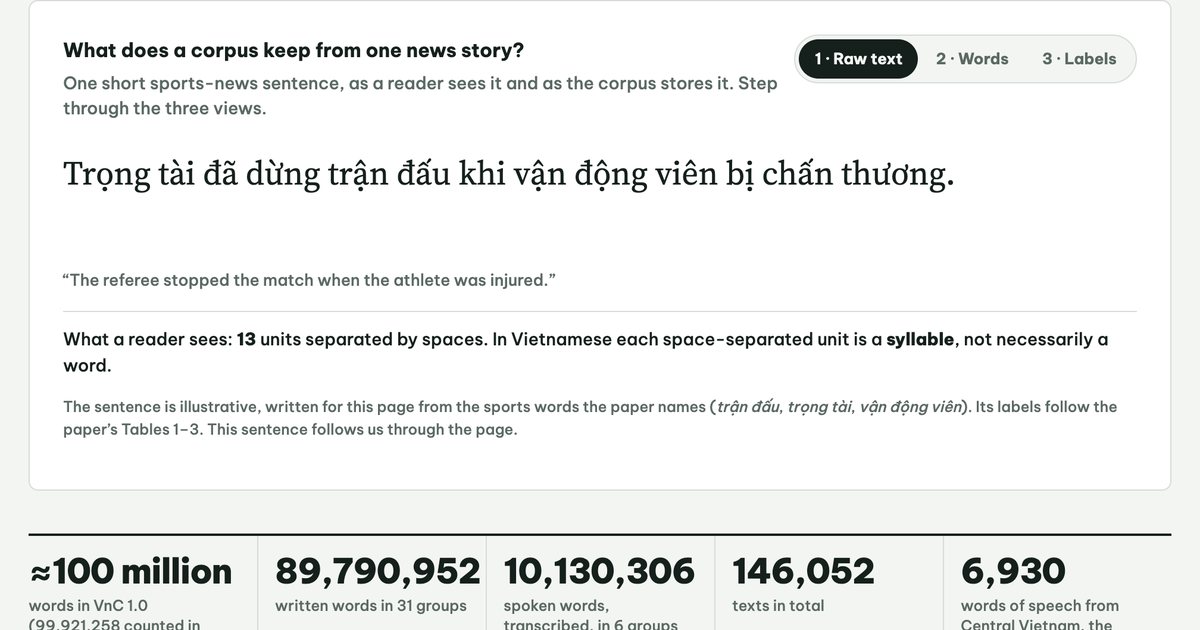
Every application below depends on two things done to each text: splitting it into words and tagging each word’s role. Follow our running sentence from a raw web page to a tagged line.
What happens to one sentence on its way into the corpus?
Step through, or pick a step.
Source: Sections 3.2 and 3.3. The raw page and the typo in steps 1–3 are illustrative: the paper names the kinds of noise removed and errors fixed, not this example. The final segmented line is exactly as it appears in the paper’s Figure 4.
For researchers: processing and annotation details
Removed: tables, diagrams and footnotes (mainly from annual reports); images, video and hyperlinks (mainly from online news).
Normalised to plain text (.txt), Unicode UTF-8. Errors checked: typing errors, spelling errors, tone-mark placement errors.
Sentence segmentation per text.
Word-boundary and part-of-speech tags assigned automatically with the tagging toolkit of the Computational Linguistics Center (CLC_VN_Tookit, as spelled in the paper; ref. [2]). The paper reports no accuracy figure for this tagging and no manual check of the tags.
Step 4 matters more in Vietnamese than in English. Vietnamese is written with spaces between syllables, not words: bắt đầu (“start”) is one word spelled as two syllables. joins them, here with an underscore, so the corpus counts bắt_đầu once instead of counting bắt and đầu separately. Then marks each word’s role, which is what lets the corpus tell two meanings of the same spelling apart (Part 4).
3 · Choosing words to teach
A few thousand words carry most of Vietnamese text
Learners cannot learn every word at once, so the first question for any course is: which words first? The corpus answers by counting. For every word it records n, how many times the word occurs among the corpus’s N = 100,189,286 words, and a computed from that ratio.
A smaller f means a more common word. That is the opposite of what most people expect, so keep it in mind for the next three figures.
Which Vietnamese words are used most?
Tap a word.
Source: Table 3. The paper prints ranks 1–5, 20, 50, 100 and 1000 only; the gap marks the skipped ranks. The paper writes numbers with a decimal comma (f = 1,930; n = 1.396.663); they are shown here in English notation with the same digits. Notice how fast counts fall: the 1000th word, giường (“bed”), occurs 13,830 times, against 1,396,663 for the top word, và.
For researchers: Table 3 in full
POS tags as defined in the paper: Cm preposition, Cp conjunction, Vc copula, R adverb, Ve existential verb, Pd spatial/temporal pronoun, Vv volitional verb, Aa qualitative adjective. f = −log(n/N), N = 100,189,286.
Our running sentence already contains one of the top five: không (“not”) is the 5th most frequent word in VnC 1.0, with 1,134,897 occurrences. A learner meets it on almost every page. The counts fall off steeply after the top, which is what makes the next figure possible.
How much of the corpus can a learner read with a short word list?
Learn the most common
The word list
100 squares = every distinct word in the corpus, most common first.
334 words1% of the word list
The running text they cover
100 squares = every word occurrence in the corpus.
more than 60%of all word occurrences
Source: Section 4.1 and Figure 2. The paper states two points of its cumulative curve: the top 1% (334 words) covers “more than 60%”, drawn here as 60 squares, and the top 10% (3,334 words) covers 91.356%.
For researchers: the cumulative curve (Figure 2)
The paper’s Figure 2 plots cumulative frequency (%) against the proportion of words (%, 1 to 100). Its plotted values are not printed, so only the stated points are drawn below; the line between them is a guide, not data.
This is the practical result for teachers. A list of about 3,300 common words covers more than nine in every ten words a learner will meet in VnC 1.0. From the same frequency ranking, a course can build graded lists: the 1,000 most common words, then 2,000, then 3,000.
Think of it asPacking for a trip: a small bag of everyday clothes covers nearly every day; the rare outfits take up the rest of the wardrobe.
The same spelling, two words
Frequency alone hides something. của is a preposition, “of”, and also a noun, “property, belongings”. A plain count adds the two together. The part-of-speech tags from Step 5 keep them apart, and the gap between them is large.
Which “của” should a beginner learn first?
← more common (smaller f)rarer (larger f) →
Source: Section 4.1 and Table 3. The noun của (f = 4.510) is rarer than giường (“bed”, f = 3.934), the 1000th most common word. So the preposition belongs in week one; the noun can wait.
4 · Real sentences in class
Every word comes with real sentences
Römer, whose overview the paper follows, sorts the uses of a corpus in second-language teaching into two branches. VnC 1.0 is meant to feed both.
Who uses a corpus in language teaching, and how?
Applications of corpora in teaching
IndirectSupport for researchers and compilers of teaching materials
Compiling textbooksVnC 1.0: graded readings by topic, genre and level
Compiling reference and teaching materialsVnC 1.0: word lists ranked by frequency
DirectSupport for students and teachers ()
Teachers use corpora in teachingVnC 1.0: concordances for real examples
Students use corpora in learningVnC 1.0: collocations in context
Source: Figure 1 of the paper, after Römer (2011, p. 207). The grey “VnC 1.0” notes pair each branch with an application from Section 4 of the paper; the pairing is ours, for orientation. The paper itself says only that VnC results serve teaching both directly and indirectly.
Graded readings. A textbook needs texts of the right difficulty for each level. From VnC 1.0, compilers can pull readings on many topics (culture, education, law, sport) from different genres (books, newspapers, reports) at each level (easy, intermediate, difficult). The paper’s point is that this keeps textbook writing from resting on intuition alone.
Try it first: which pair sounds Vietnamese?
Words that habitually go together are called . Foreign learners find them hard to understand and hard to remember, because nothing in the meaning tells you which combination is the normal one.
Pick the combination a Vietnamese speaker would use
Each pair means roughly the same thing word for word. Only one is idiomatic.
Source: Section 4.4, where the paper prints the non-idiomatic member of each pair struck through. English glosses are ours.
A learner cannot guess these. A corpus can show them, by listing every line in which a word appears and letting patterns jump out. Back to ăn kiêng from our hero: this time, ask which words sit right next to it.
Which words travel with “ăn kiêng”? Let the lines show you
Pick a neighbour pattern; matching lines stay bright.
Source: Figure 4 of the paper (10 lines). Counts refer to these lines only, not to the whole corpus.
Two things to notice. For ăn kiêng, the lines show both a habit (chế_độ ăn kiêng, “diet regime”, in 6 of 10 lines) and a figurative use (chế_độ ăn kiêng tinh_thần, a “mental diet”, in 4). Every one of these is a sentence somebody actually wrote, which is what the paper means by examples from real use.
What we learned
Four takeaways
The material rests on a balanced corpus, not a news archive. VnC 1.0 holds 100,189,286 words, 90% written and 10% spoken, from all three regions, mainly from 2000 to 2020; the corpora used for teaching Vietnamese before held only online news.
A short list covers most text. The 334 most common words (1%) cover more than 60% of the corpus; the 3,334 most common (10%) cover 91.356%, a basis for graded 1,000-, 2,000- and 3,000-word lists.
Part-of-speech counts tell teachers which meaning comes first.của as “of” scores f = 1.943; của as “property” scores f = 4.510, rarer than the 1000th word.
Real sentences replace invented examples. Concordance lines such as those for chế_độ ăn kiêng (“diet regime”) show learners how words are actually combined.
The authors plan to keep growing VnC: more text samples, adjusted proportions between kinds of text, and more linguistic annotation.
Notes, data provenance and limitations
Data provenance
Written texts: material already available electronically (Word files, e-books, web articles), including National Assembly documents and company annual reports from official websites.
Spoken texts: subtitles of videos, Vietnamese and English films, National Assembly sessions from quochoi.vn, and some manual transcription from video.
Word boundaries and part-of-speech tags are automatic (CLC toolkit); the paper reports no accuracy check of these tags.
Limitations
The paper shows how VnC 1.0 can be applied to teaching; it reports no classroom experiment measuring learning gains.
Apart from the 90% / 10% written–spoken split, no breakdown by genre, domain, region, period or author is given, so balance cannot be checked from the paper.
Table 3 shows selected ranks only (1–5, 20, 50, 100, 1000). Figure 2’s curve values are not printed; this page draws only the stated points.
The paper defines f = −log(n/N) without naming the logarithm’s base; f values are reproduced as printed.
The paper gives no public download link or licence for VnC 1.0.
About this page
VnC 1.0 itself was built and described in an earlier paper (see VnC 1.0 Explained); this page recaps only the design points the teaching applications rely on.
Built from an English translation of the Vietnamese original, transcribed from the PDF and checked against page images. The translation has not yet been reviewed by the authors.
English glosses of Vietnamese words and concordance lines are ours. The raw page and typo in the processing stepper are illustrative. The pairing of Figure 1’s branches with VnC applications is ours. Every number comes from the paper.
Cite this paperNhu Vo, Thuy Bui, Tran Phan, & Dien Dinh. (2022). Vietnamese Corpus Construction for Teaching Vietnamese to Foreigners. Linguistic Journal, Vietnam Institute of Linguistics, 375(1), 13-22. https://jol.vn/index.php/ngonngu/vi/article/view/977/896
 FAIR 2020Picking 100 million words that stand for Vietnamese14 min read
 Vietnamese Dictionary & Encyclopedia 2020Collecting real Vietnamese text to write dictionary entries from12 min read